

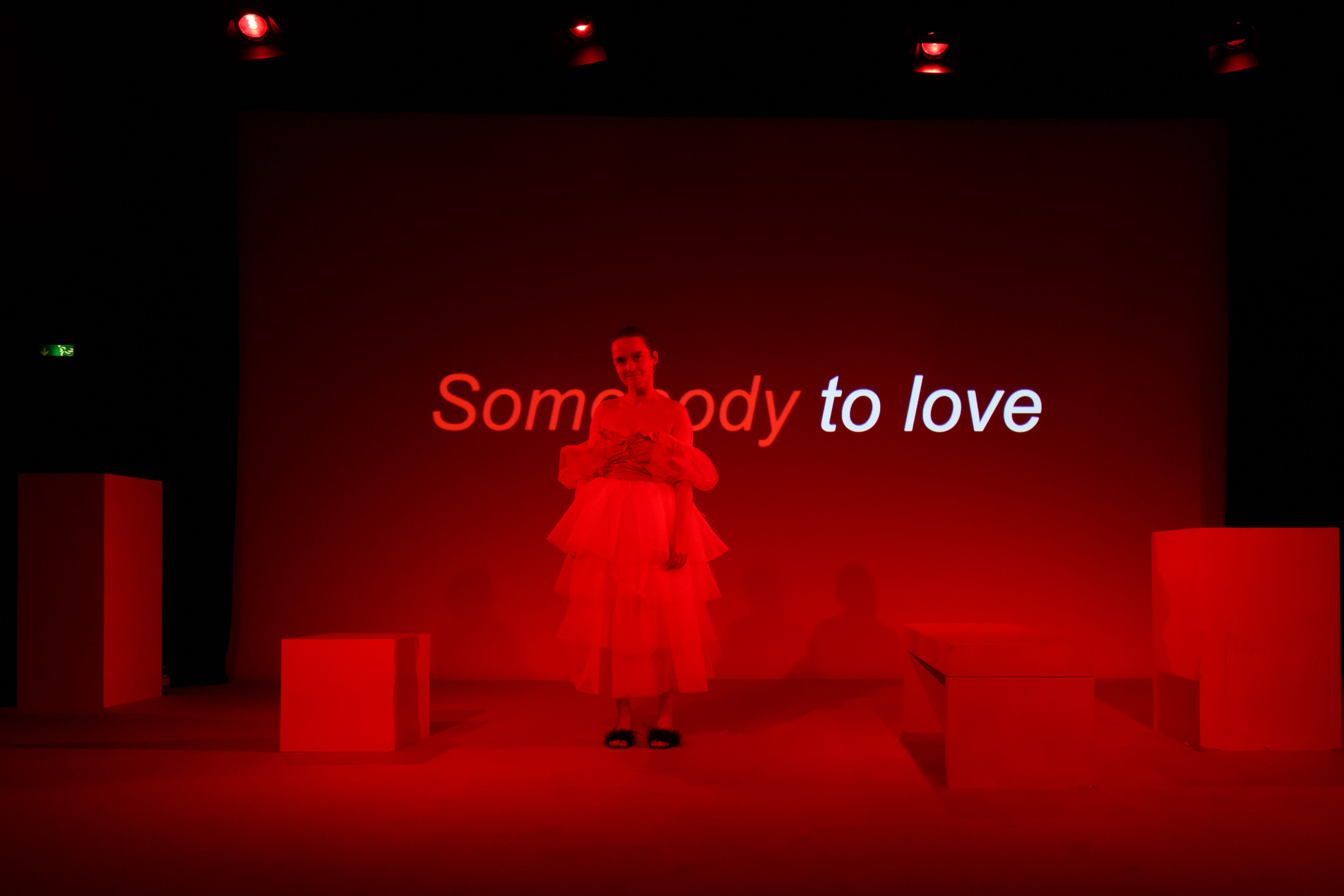
Marijke De Roover, Live, Laugh, Limerence, 2020. Performance at MOVE 2021, Centre Pompidou, Paris, 9 October 2021.
Photo: Herve Veronese
This year we lost three extraordinary women whose lives and work, in very different ways, have intersected with my own: Simone Forti, JoAnne Bland and, most recently, my dear friend and collaborator Marijke De Roover.
Their lives could hardly have been more different. Simone was an artist, dancer and choreographer whose work fundamentally expanded the possibilities of movement and improvisation. JoAnne was a civil rights activist who, as a child in Selma, Alabama, marched for voting rights and was arrested numerous times before she was even a teenager. Marijke was an artist, performer, musician, writer and friend whose work moved restlessly between performance, theatre, music, politics, feminism, queer culture and collective participation.
I had the privilege, in different ways, of encountering all three of them through my own life and work. And losing them in such proximity has made me think about what exactly we mean when we talk about an artist’s—or anyone’s—legacy.
What survives?
And perhaps more importantly: how does it survive?
Things that happen in other people
I’ve worked with Jeremiah Day for many years. Jeremiah in turn worked closely with Simone Forti, developing an artistic relationship through which her approaches to movement, improvisation, speaking and thinking became entangled with his own practice.
I spoke to Jeremiah recently about Simone and about the strange process that begins when somebody dies and a life starts becoming a legacy.
Estates and foundations have an important job to do. There are works to conserve, archives to organise, rights to protect and histories to establish. But inevitably there is another, messier history too.
Artists teach. They collaborate. They argue. They share methodologies. They participate in political life. They influence people who then go somewhere else and do something entirely different.
Jeremiah isn’t simply reproducing Simone’s work. He is an artist in his own right. But something of Simone travels through his practice: through teaching, workshops, movement, conversation and the continuing exploration of ideas they worked with together.
Simone Forti 1935 — 2026
Simon Forti with Jeremiah Day, 2018. The Emily Harvey Foundation, New York
photo: James Welling
It made me think that perhaps some of the most consequential things an artist produces aren’t artworks at all.
They are things that happen in other people.
The mythology of art has always had difficulty with this. It prefers the singular artist: a name, an authorship, a body of work, an exhibition history, objects that can be catalogued, conserved, exhibited and collected.
It is much harder to account for the network of friendships, collaborations, arguments, teaching, generosity and participation through which culture actually moves.
Walking forward
JoAnne Bland’s legacy makes this visible in an entirely different way.
JoAnne Bland was eleven years old when she took part in the 1965 voting-rights marches in Selma, including Bloody Sunday and the Selma-to-Montgomery campaign. She had already been involved in the struggle for civil rights from an extraordinarily young age.
What does it mean to preserve a life like JoAnne’s?
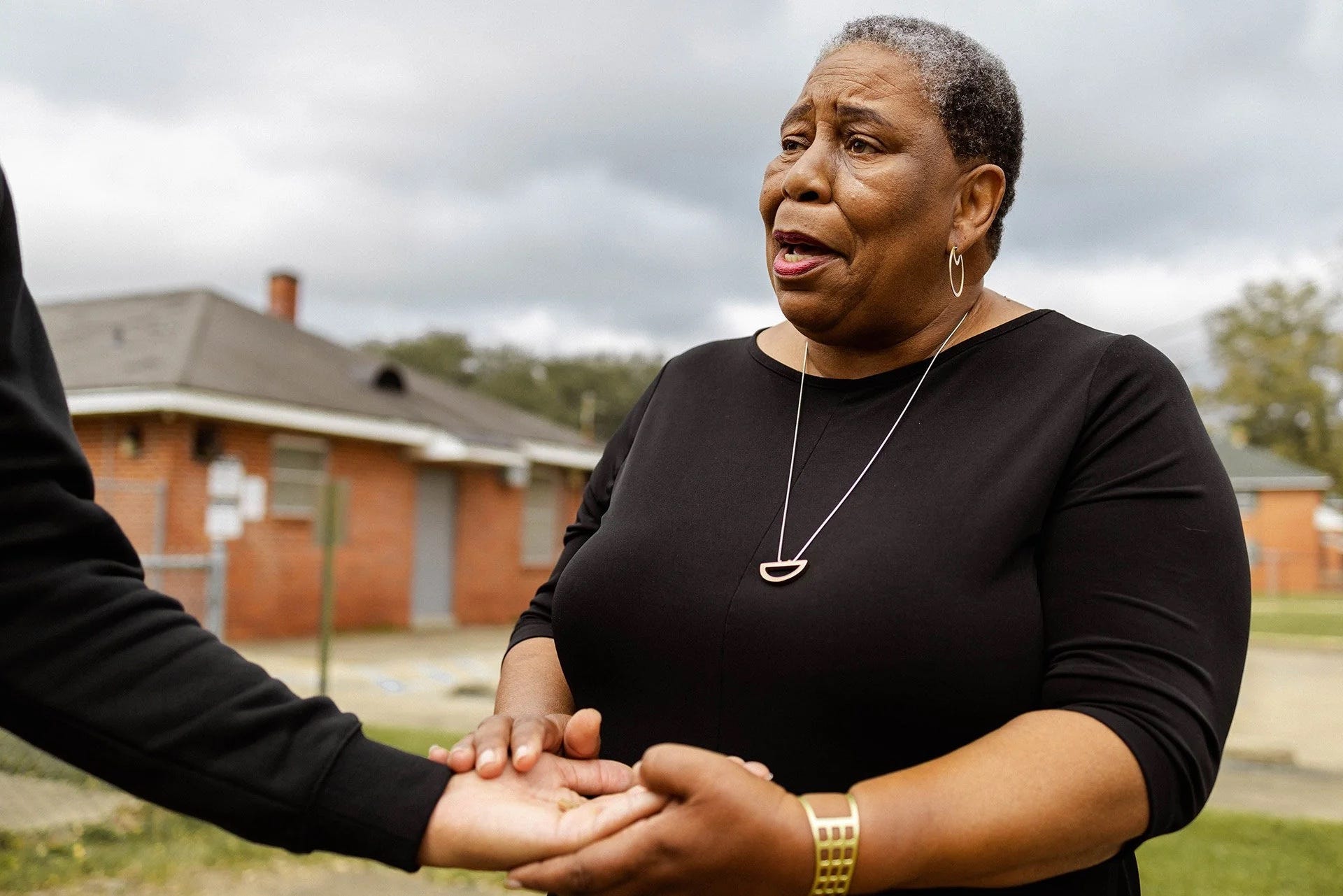
JoAnne Bland 1953 — 2026
There are photographs, documents and historical sites, of course. They matter enormously. But the real continuation of that history happens every time the story is told.
A young person hears what happened in Selma.
Someone learns that children were part of the civil rights movement.
Someone understands that the freedoms they experience today were fought for by ordinary people who decided that something was intolerable.
And perhaps that knowledge changes what they believe they themselves are capable of doing.
The march ended. The walking didn’t.
Politics, like culture, is transmitted.
Marijke
And then, devastatingly, there is Marijke — my dear friend, my ‘bestie’.
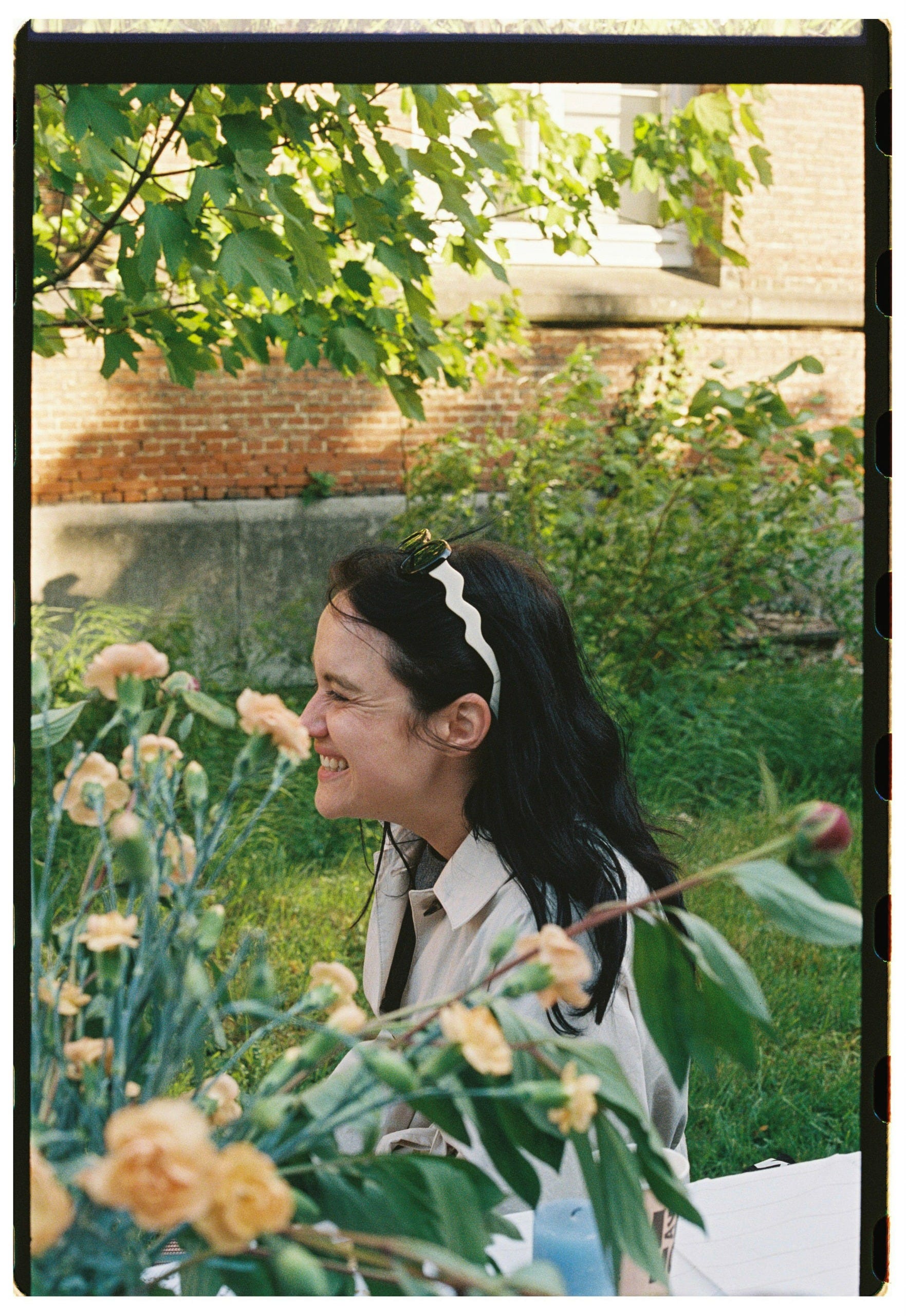
Marijke De Roover 1990 — 2026
I’ve spent much of the last few weeks thinking with friends, family and collaborators about what happens now. There are immediate and necessary questions about works, websites, archives, documentation, scripts and rights.
But I keep returning to another question:
How does Marijke’s work remain alive?
This feels particularly important because so much of her practice resisted being contained within an object.
Marijke worked with performance, music, scripts, theatre, karaoke, language, humour and participation. Her work dealt with feminism, sexuality, queer politics, freedom and the possibility of inhabiting another person’s voice.
People weren’t simply audiences for Marijke’s work. They were often implicated in it.
My last experience of one of her works made that fairly literal. At Cum as Your Madness at KIOSK in Ghent — realised with curator Simon Delobel and the extraordinary team of performers, collaborators and technicians around her — I arrived, signed a waiver and was promptly ordered to take my fucking clothes off. I stripped down to my underpants, put on a hessian sack, was paraded into another room, strapped to a chair, had my feet whipped, and was eventually instructed to crawl around on my hands and knees squealing like a pig.
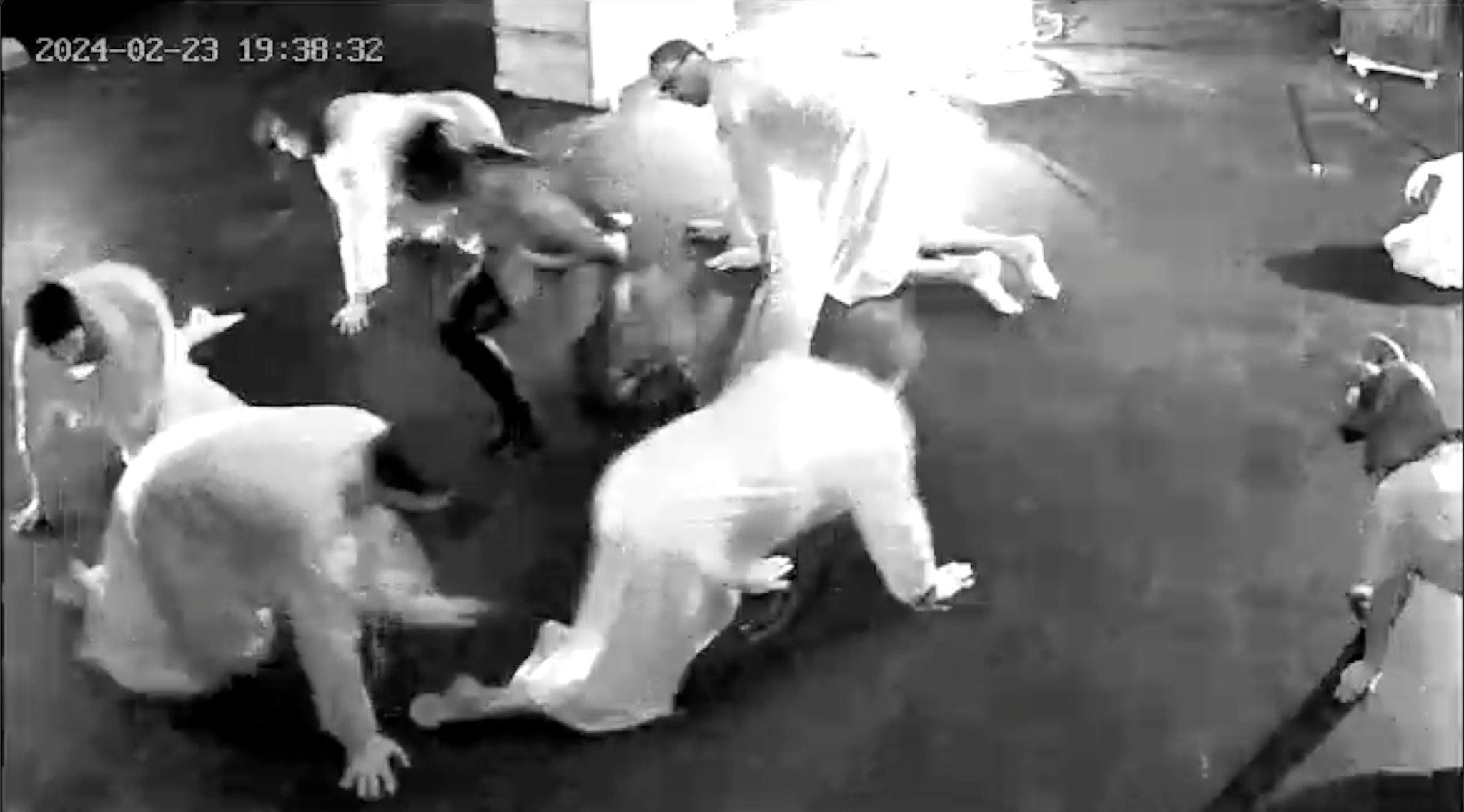
Marijke De Roover, Cum as your Madness, KIOSK, Ghent, 2025
It was one of the most liberating, ridiculous and strangely cathartic experiences I’ve ever had with an artwork.
And Marijke could not have made that experience alone. Her extraordinary imagination required other people willing to enter it with her: performers, collaborators, technicians, a curator and an institution prepared to take the risk of producing something so ambitious and unruly. That seems important to acknowledge too. The mythology of the singular artist can obscure the ecology of people through whom an artwork actually becomes possible.
Throughout Marijke’s work, people spoke.
They sang.
They performed.
They gathered.
Which creates an interesting problem when we think about posterity.
A painting can be stored.
A sculpture can be conserved.
A script can be archived.
But a performance ultimately requires someone to perform it.
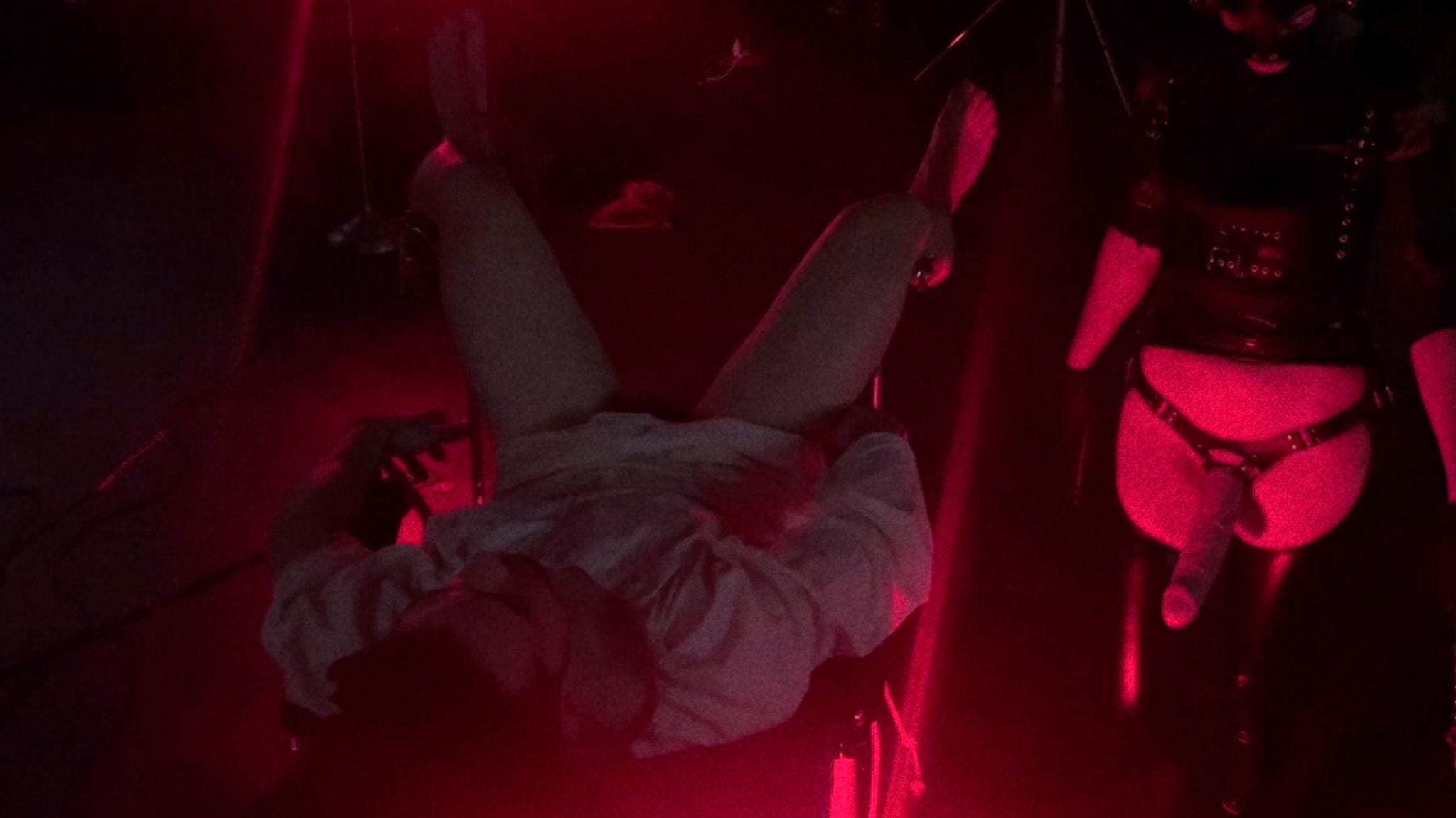
Marijke De Roover, Cum as your Madness, KIOSK, Ghent, 2025
The Dolly Parton Tour Bus
That question of where a performance might live was something Marijke and I had already talked about long before it became a question of legacy.
I often wished we’d had the resources to take Marijke’s work further outside the usual contemporary art institutions. We did this in smaller, scrappier ways. One night at The Glory on Kingsland Road, we more or less hijacked one of Jonny Woo’s open-mic cabaret nights — or at least that’s how I remember it.
I was always curious about what might happen if that side of her work entered other worlds altogether. We talked about the Edinburgh Fringe. I’d first seen Jerry Springer: The Opera there, and Marijke and I shared a love of that particular collision of the theatrical, musical, ridiculous and politically outrageous. We later went to see The Book of Mormon together in London.
I remember saying how amazing it would be to take some of her performances to Edinburgh — to put them into that unruly melting pot and see what happened when they met audiences beyond the art world.
Marijke thought about this and said that if we did it, she wanted her own tour bus, with a giant picture of herself spray-painted down the side like Dolly Parton.
That summed her up rather perfectly.
And then, exactly a month after Marijke died, we lost Dolly too. Suddenly that ridiculous imaginary minibus became an unexpectedly poignant thing to remember. I can still see it completely.
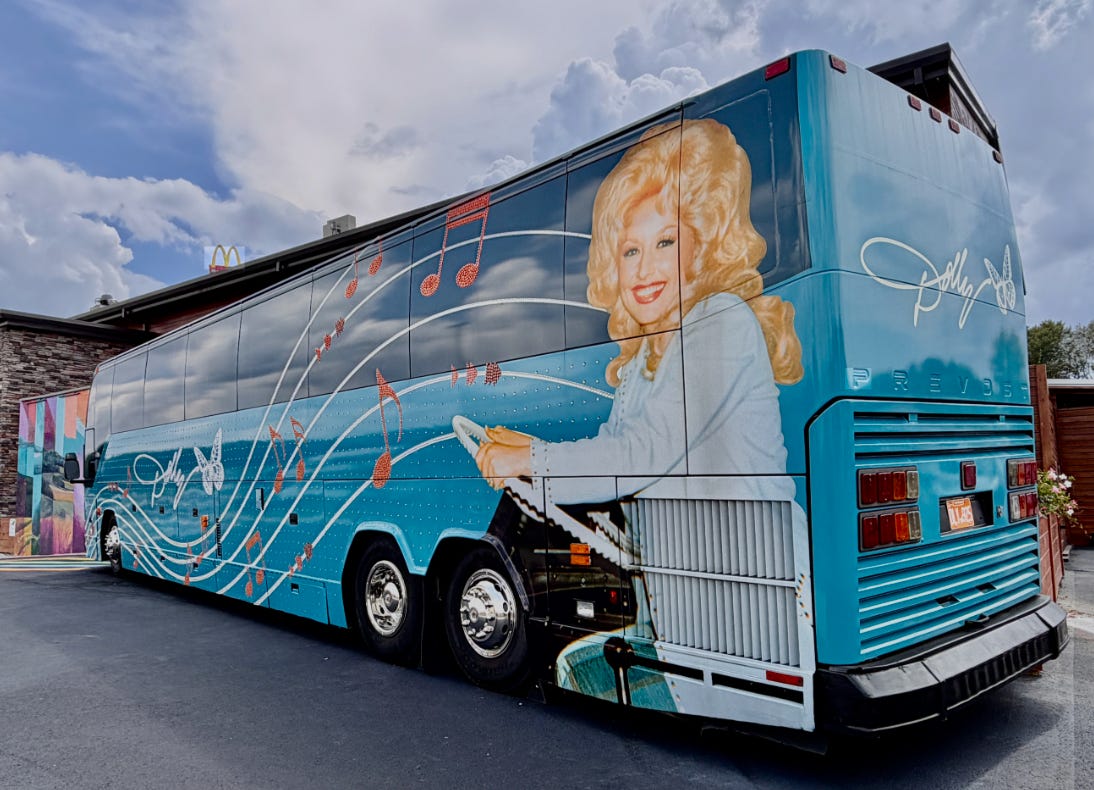
Dolly Parton Tour Bus
The Feast
This is something I’ve been thinking about particularly in relation to The Feast, a work by Marijke that we had been developing and hoping to produce.
The script exists.
But preserving the script and preserving the work aren’t necessarily the same thing.
For The Feast to live, people need to come together. Performers need to be found and paid. Rehearsals need to happen. A space needs to be made available. Someone needs to produce it. An audience needs to encounter it.
And then something unpredictable happens between all those people.
Perhaps production itself can therefore become a form of preservation.
Not attempting to recreate Marijke. Not pretending that her absence doesn’t fundamentally change the work. And certainly not claiming ownership over something that belongs to a much larger network of family, friends and collaborators.
But creating the conditions in which her ideas can continue to encounter people who never had the privilege of knowing her.
That, increasingly, is where I feel I might be useful.
What is a gallery for?
All of this has also made me reconsider a question that has been sitting underneath Arcade for some time.
What is a gallery actually for?
One answer is beautifully straightforward: artists make things, galleries present them, people encounter them and sometimes people buy them.
I still believe deeply in that.
I love paintings. I love sculpture. I love exhibitions. I believe in collecting and in the extraordinary relationship that can develop between a person and an object they choose to live with.
But surely the cultural value produced by artists is larger than the objects that can be exchanged through a market.
Knowledge has value.
Stories have value.
A dance has value.
A recipe has value.
A song has value.
Knowing how to grow something, cook something, carve something, repair something or perform something has value.
Knowing what happened in Selma has value.
Knowing a movement that Simone Forti taught someone who subsequently teaches it to somebody else has value.
Standing in a room and speaking words written by Marijke has value.
These things create relationships between generations and between strangers. They contribute to belonging, agency, collective memory and our understanding of ourselves as participants in society rather than simply consumers of it.
Perhaps a gallery can be part of that infrastructure too.
Not instead of presenting and circulating artworks, but in addition to it.
A place where cultural knowledge is transmitted.
A place where somebody can encounter an extraordinary object on Thursday, learn something from an artist on Friday, cook and eat with strangers on Saturday, and hear a story that changes how they understand the world on Sunday.
A place that doesn’t only ask what culture is worth, but asks what culture does.
The show must go on
I’ve always understood the phrase “the show must go on” as slightly brutal.
Something terrible has happened, but the curtain rises anyway.
After losing Marijke, I’ve started to understand it differently.
Perhaps the show going on doesn’t mean carrying on as though somebody hasn’t gone.
Perhaps it means recognising everything they set in motion.
Simone’s work continues in people who learned from her, collaborated with her and developed those encounters into practices of their own.
JoAnne’s courage continues every time her story equips another person to understand that political change is something ordinary people can participate in.
And Marijke’s work can continue through every person who performs it, sings it, argues with it, learns from it or takes one of its questions somewhere none of us can anticipate.
An archive matters.
An artwork matters.
A history matters.
But culture isn’t only something we inherit.
It is something we hand on.
Perhaps “the show must go on” has never meant carrying on without someone.
Perhaps it means carrying something forward because of them.
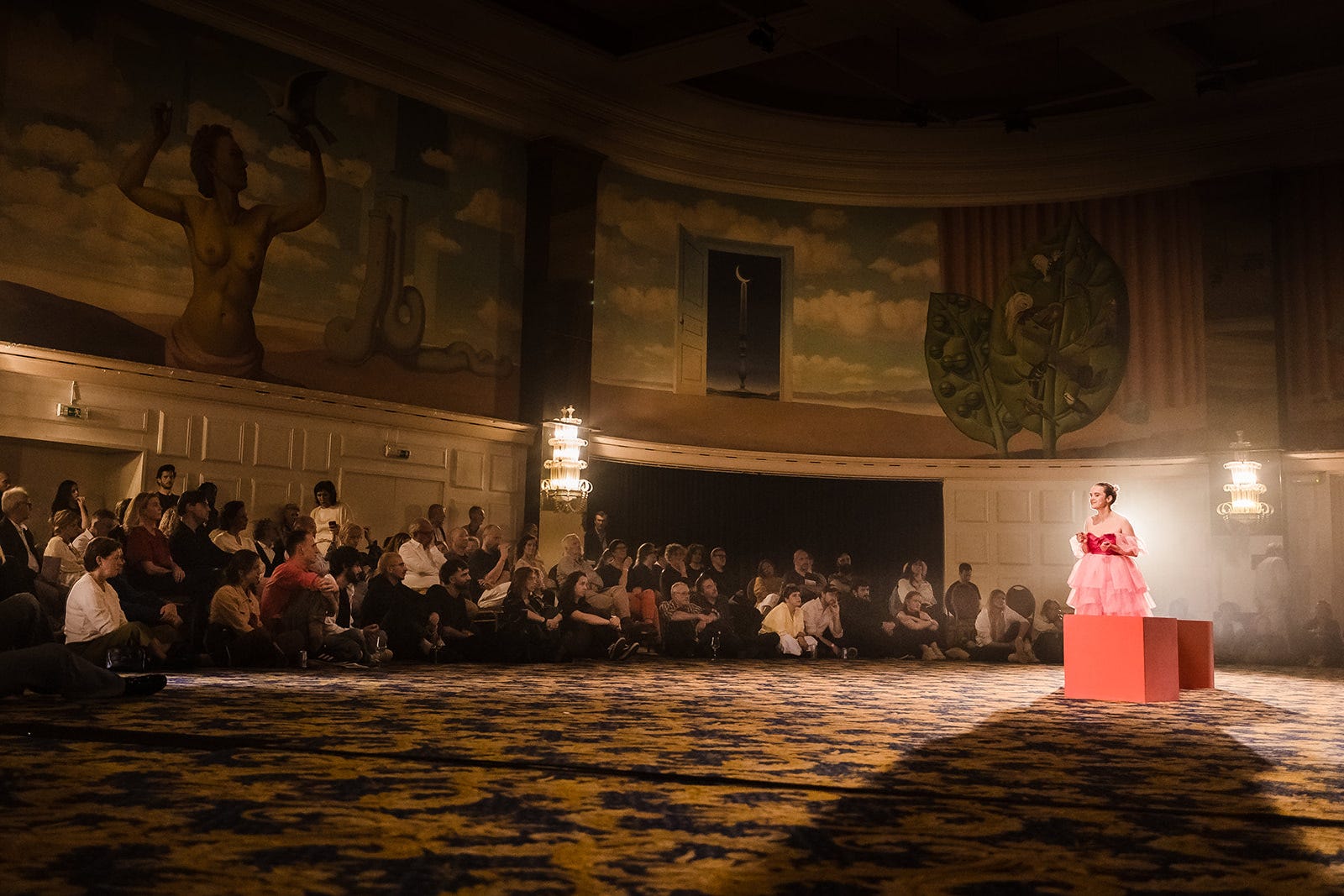
Marijke De Roover, Live, Laugh, Limerence, 2020. Performance at INDISCIPLINE, WIELS / Grand Casino Knokke-Heist, 29 October 2022.